The Lake County seat, on the Grand River, about thirteen miles north of our Chardon yard.
Painesville is the Lake County seat, sitting on the Grand River a couple of miles in from Lake Erie and roughly thirteen miles north of our Chardon yard. It’s an old town by Ohio standards — the county was carved out of Geauga and Cuyahoga in 1840 and Painesville has been the seat ever since — and it has the tree stock to match. Downtown historic districts, Lake Erie College, and streets lined with trees that predate most of the houses under them.
Old street trees over old houses is careful work. There’s rarely room to fell anything, utility drops run straight through the canopy, and a mature tree on one of these streets is worth keeping if it can be kept. So most of what we do here is pruning — deadwood out, weight off the roof, clearance from the service line — and removal only where the tree is genuinely finished.
Lake County is also where beech leaf disease started. It was first spotted here in 2012, in Lake Metroparks, and has since moved through more than a dozen Ohio counties and on into Pennsylvania, New York, and Ontario. American beech in this area are thinning from the top down, and a beech that has lost its upper crown is standing deadwood — brittle, unpredictable, and a removal rather than a save.
Then there’s the river valley. Grand River bank properties have steep ground, undercut banks, and trees leaning out over the water with half a root plate in the air. Those come out by crane more often than not. We cover Painesville, Painesville Township, and tree service in Mentor from the same yard.
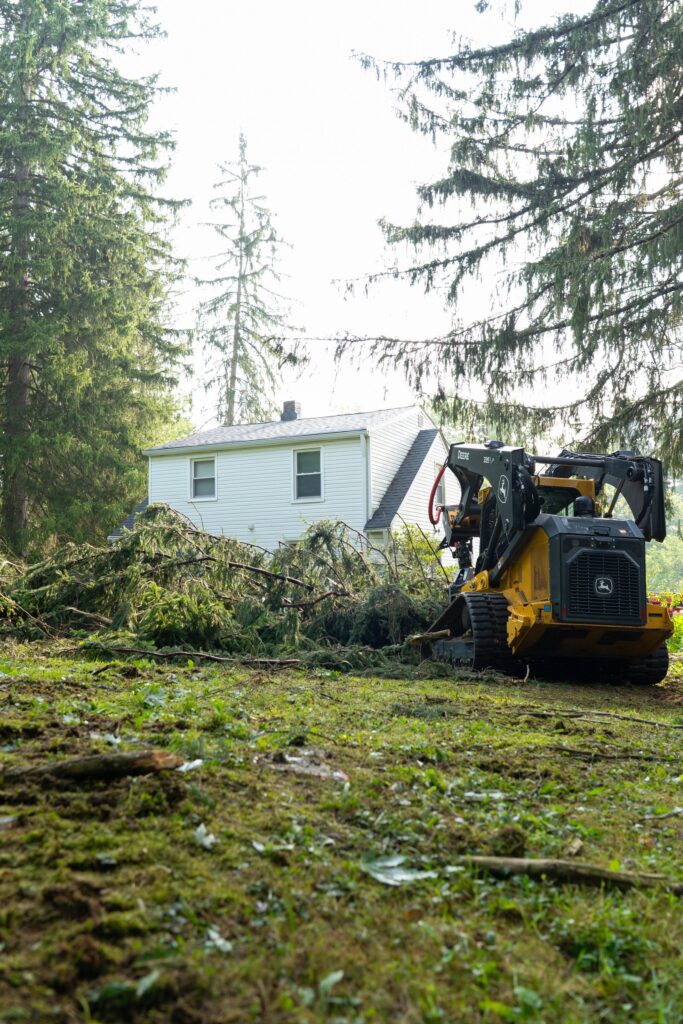
An old town on a river valley, in the county where beech leaf disease was first found.
First identified in Lake County in 2012. Beech here are thinning from the top down, and a bare upper crown means the tree is done.
Old houses, close spacing, and mature trees over both. Nothing on these streets gets felled.
Steep, undercut banks and trees leaning out over the water with part of their root plate in air.
Old streets run the utility line straight through the tree. Clearance pruning is a job of its own.
Emerald ash borer came through years ago. What's still standing is brittle and getting worse each winter.
Beech, banks, and old-street pruning — what we get asked here.
Most likely beech leaf disease. It was first observed right here in Lake County in 2012 and has spread across Northeast Ohio since. It shows as dark banding between the leaf veins, then curled and shrunken leaves, then dieback from the top down. There’s no treatment a homeowner can apply that reverses it. Early on it’s worth monitoring; once the upper crown is bare, the tree is standing deadwood and should come down before it starts dropping limbs on its own.
For a tree on your own property, generally not. Trees in the tree lawn or the road right-of-way are a different matter — those belong to the city and aren’t yours to have removed. Properties inside a historic district can carry additional review, and some older parcels have utility easements running through the back. Tell us where the tree stands and we’ll confirm with the city before anything gets scheduled.
Usually, but it changes how the job gets done. A tree on an undercut bank has already lost part of its root plate, so it can’t be climbed the way a sound tree can, and there’s nowhere below to drop anything. Those are typically crane removals — we reach in from stable ground and lift the sections out. We’ll tell you at the estimate if that’s what yours needs.
All of it. Painesville, Painesville Township, Mentor, Concord, Perry, Madison, Willoughby, and Kirtland are all a short run north from the Chardon yard and we’re up here most weeks. There’s no travel surcharge for any of it.
Beech, ash, river banks, or an old street tree over the roof. Text or call (440) 636-2276.