Some trees are too dead, too tall, or too close to the house to climb. Our crane reaches about 100 feet and lifts them out in big pieces — with the operator on the ground the whole time.
The safest way to take down a dangerous tree is to keep people out of it. Our crane truck pairs a Palfinger PK65 knuckle-boom with a Mecanil grapple saw, and the whole rig runs on remote control from the ground.
The grapple takes hold of the limb before the saw ever touches it, so each piece is carried down instead of dropped. That lets us work directly over a roof, a fence, a pool, or a septic field and set every section down exactly where we want it. It’s how most Chagrin Falls tree removals get done, where the village lots leave no drop zone at all.
It also means fewer cuts, bigger pieces, and far less time in your yard. It matters most on storm-damaged trees, where the trunk is already compromised and climbing is the last thing anyone should do. See how it fits into our tree removal service, or check the tree removal FAQ for what drives cost and timing.
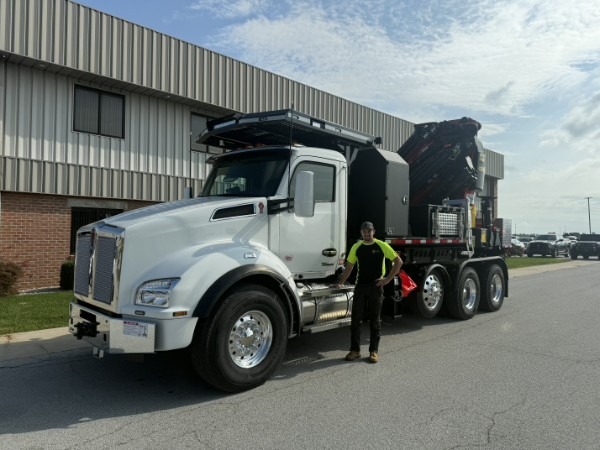
Not every removal needs one. These are the jobs where it makes the difference between risky and routine.
A compromised trunk can't be trusted to hold a climber's weight. The crane never asks it to.
We reach over the roofline from the driveway and lift each piece away from the structure instead of toward it.
About 100 feet of reach covers the mature oaks, maples, and pines that a lift truck can't get near.
Pools, patios, septic fields, and landscaping come through intact when nothing is dropped on them.
Bigger pieces mean fewer trips. Removals that would take two days often finish in one.
One machine doing the work of a climbing crew, a bucket truck, and a loader — safely, from the ground.
The knuckle-boom that does the lifting. It folds out and over obstacles instead of only working straight up.
Enough height and outreach to work over a house, a garage, or a fence line without leaving the driveway.
Grabs the limb, cuts it, and keeps hold of it. Nothing free-falls toward your yard.
The operator runs the crane from the ground with a clear view of the tree, the load, and the crew.
A heavy vocational truck built to carry the crane and stay planted on uneven ground.
What people ask when they see the crane truck pull up — or before they book it.
The short version: if it’s dead, hollow, or rotten, if it’s leaning over the house, if it’s taller than a bucket truck can reach, or if there’s a pool, patio, or septic field underneath it. Any tree whose trunk can’t be trusted to hold a climber is a crane job. Text us a photo of the tree and what’s around it and we’ll tell you straight whether it’s warranted.
Usually not. The Palfinger PK65 knuckle-boom gives us roughly a hundred feet of reach and folds up and over obstacles rather than only working straight up, so most jobs are run from the driveway or the street. The outriggers set down on pads to spread the load. We’ll look at your access during the estimate and tell you exactly where the truck needs to sit.
That’s the whole point of the setup. The Mecanil grapple saw takes hold of the limb before the saw touches it and keeps hold of it after the cut, so nothing free-falls. Each piece gets carried clear and set down where we want it. The operator runs the crane by remote from the ground with a clear view of the tree, the load, and the crew.
Not automatically, and sometimes it’s less. Bigger pieces mean fewer cuts and fewer trips, so a removal that would take a climbing crew two days can finish in one — and the labor saved offsets a good deal of the equipment. Where it clearly wins is risk: a hazardous tree over a structure is far cheaper to crane out than it is to repair a roof.
Most residential removals are a single day, setup to cleanup. Access, what’s underneath the tree, and how far the debris has to be carried matter more than the size of the tree itself. If you need it done inside a specific window — before a party, a closing, or a contractor’s start date — tell us when you call and we’ll be honest about whether we can hit it.
That’s where it matters most. A tree that’s split, uprooted, or hung up in another tree is already structurally compromised, and putting a climber in it is the last thing anyone should do. Our 24/7 emergency crew can bring the crane out for exactly these situations.
Send us a photo and we'll tell you whether the crane is the right call. Text or call (440) 636-2276, or request a free, no-obligation estimate online.